European Components Market Continoued Strong Growth in 2026 Q3:
Industrial demand and Memory dynamics underpin a steady expansion across regions and product groups.
2026YTD Key facts:
- European electronic components distribution reached €15.0 billion, up 30.2% year-over-year, with an exceptionally strong Q3 delivering €5.4 billion, a 42.7% increase versus Q3 2025.
- Semiconductors remained the primary growth engine, rising 36.9% YTD to €9.5 billion, while Q3 alone surged 53.3% to €3.5 billion.
- Interconnect, Passive & Electromechanical components (IP&E) advanced by 20.3% YTD to €5.6 billion, supported by broad-based industrial demand and a strong Q3 growth rate of 26.9%.
- Europe's electronics sector continues its recovery with increasing momentum across key product categories, although geopolitical uncertainties and potential energy-related disruptions remain factors requiring close monitoring.
Key quote:
"The European electronics market has entered a phase of accelerated recovery, with growth strengthening throughout 2026 and extending across both semiconductor and IP&E technologies," said Hermann Reiter, Chairman of DMASS Europe. "Particularly encouraging is the breadth of this expansion. While semiconductors continue to lead the market, we are also seeing solid progress across interconnect, passive and electromechanical products, reflecting healthier demand fundamentals throughout the value chain. Europe’s competitive advantage remains its exceptional application expertise, engineering excellence and ability to transform innovation into industrial solutions. Although geopolitical uncertainties require vigilance, the current trajectory gives us confidence that the industry is building a more resilient and sustainable foundation for future growth."
Note to editors: DMASS Europe represents ~88% of European components DTAM.
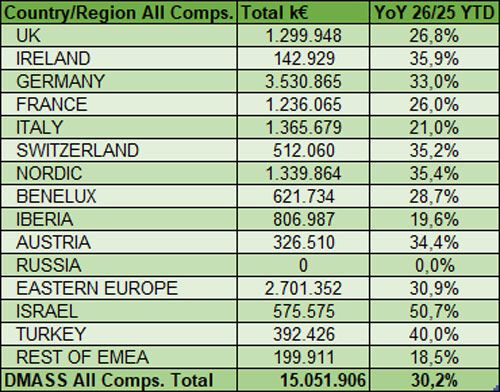
Berlin, Nov 04th, 2026 – The European electronic components market reached €15.0 billion (+30.2% YoY YTD), reflecting a broad-based recovery across most European markets. Growth momentum remained strongest in Israel (+50.7%), where continued investment in aerospace, defense, AI and advanced technology applications supported exceptional demand. Ireland (+35.9%), likely benefiting from its concentration of global cloud, server and data-center activities amid the sharp recovery in memory products, also remained among the strongest performers. Solid above-market growth was further recorded in the Nordics (+35.4%), Switzerland (+35.2%), Austria (+34.4%) and Germany (+33.0%), underlining the recovery of Europe's key industrial and technology-driven economies.
Growth was somewhat more moderate in Southern Europe, although France (+26.0%), Italy (+21.0%) and Iberia (+19.6%) all continued to post healthy gains. The UK (+26.8%), Benelux (+28.7%), and Eastern Europe (+30.9%) also delivered solid double-digit growth, highlighting the increasingly widespread nature of the current upturn across the region.
All Components consolidated by Region (Q3 YTD):
Product-wise, the market continues to benefit from a combination of industrial recovery, digital transformation and ongoing investments in automation, energy infrastructure, electrification and AI-related technologies. While the extraordinary expansion of the memory segment remains an important growth contributor, the positive development across both semiconductor and IP&E product categories indicates that demand is becoming increasingly diversified and structurally supported. This broader participation across regions and technologies suggests that Europe’s electronics market is transitioning from a cyclical rebound toward a more sustainable growth phase, although geopolitical uncertainty and energy-market risks continue to warrant close attention.
Semiconductors (Q3 YTD YoY):
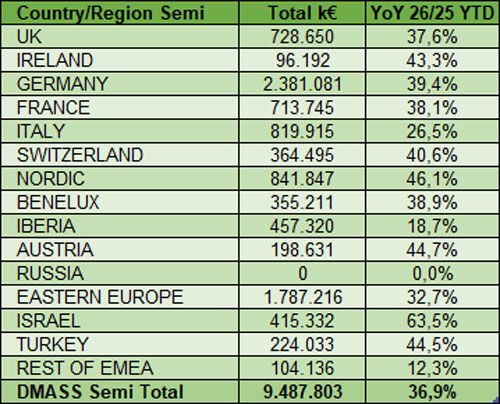
European semiconductor distribution reached €9.5 billion (+36.9% YoY YTD), confirming semiconductors as the primary driver of the ongoing market recovery. Growth was broadly distributed across Europe, with Israel (+63.5%) once again leading all major markets, reflecting continued strength in aerospace, defense and advanced computing applications. Strong performances were also reported from Nordics (+46.1%), Austria (+44.7%), Turkey (+44.5%), and Ireland (+43.3%), while the largest European market, Germany (+39.4%), delivered robust above-market growth. Switzerland (+40.6%), Benelux (+38.9%), France (+38.1%), and the UK (+37.6%) further underlined the broad-based nature of the recovery. Southern European markets expanded at a more moderate pace, with Italy (+26.5%) and Iberia (+18.7%) remaining below the European average.
On the product side, Memory (+189.4%) continued to dominate growth by a wide margin, supported by persistent pricing effects and recovering demand across multiple application sectors. Beyond memory, growth was healthy across the semiconductor portfolio, led by Discrete (+30.8%), MOS Micro Logic (+26.6%), Analog (+24.9%), and Other Logic (+23.9%), indicating renewed activity in industrial, automotive and infrastructure-related applications. Sensors & Actuators (+17.0%), Standard Logic (+14.7%), and Power products (+11.5%) also contributed positively, while Programmable Logic (+8.1%) and Opto (+1.7%) grew more modestly, suggesting that inventory normalization is still ongoing in selected segments.
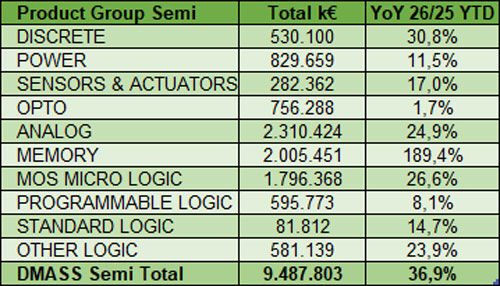
Overall, the semiconductor market continues to show increasingly broad participation across regions and product groups. While memory remains the dominant growth contributor, the strengthening performance of core industrial product categories points to a healthier and more sustainable recovery across the European electronics value chain.
Interconnect, Passive and Electromechanical Components (Q3 YoY YTD):
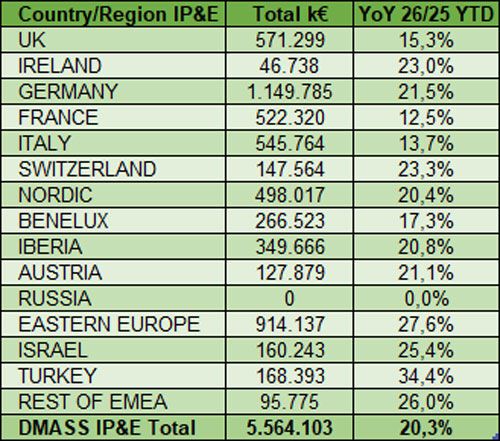
European distribution reached €5.6 billion (+20.3% YoY YTD), confirming a solid and broadly distributed recovery across Europe's industrial electronics sector. The strongest growth was reported from Turkey (+34.4%), Eastern Europe (+27.6%), Rest of EMEA (+26.0%), and Israel (+25.4%), reflecting continued investments in industrial infrastructure, transportation, defense and energy-related applications. Among Europe's established electronics markets, Ireland (+23.0%), Switzerland (+23.3%), Germany (+21.5%), Austria (+21.1%), and the Nordics (+20.4%) all exceeded the European average or remained close to it, underlining the widespread nature of the recovery. Southern European markets expanded at a more moderate but still healthy pace, led by Iberia (+20.8%), followed by Italy (+13.7%) and France (+12.5%).
On the product side, growth was remarkably balanced across all major IP&E categories, highlighting the underlying strength of Europe's industrial demand environment. Passives (+22.8%), the largest growth contributor, benefited from broad demand across industrial, energy, automation and transportation applications. Power Supplies (+19.8%) recorded similarly strong growth, reflecting ongoing investments in electrification, energy efficiency, data-center infrastructure and industrial modernization. Meanwhile, Electromechanical components (+18.9%), the largest product group by value at more than €3.1 billion, continued to expand steadily, supported by automation, connectivity and industrial equipment demand throughout Europe.
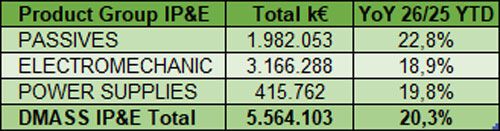
Overall, IP&E continues to provide one of the clearest indicators of underlying industrial activity. Unlike parts of the semiconductor market that remain influenced by pricing dynamics, the IP&E sector reflects a broad-based, application-driven recovery, supported by long-term investments in automation, electrification, energy infrastructure and digital transformation. This healthy and balanced growth profile reinforces confidence in the sustainability of Europe's broader electronics market recovery.
Chairman Hermann Reiter concluded:
“The third quarter reinforced the positive trend seen throughout the year, delivering the strongest quarterly performance since the market recovery began and confirming renewed momentum across virtually all major product categories.
The combination of robust semiconductor demand, improving industrial activity and broader participation from the IP&E sector suggests that the recovery is becoming increasingly balanced and sustainable. At the same time, the industry must remain attentive to geopolitical developments, trade uncertainties and potential energy-market disruptions that could affect business confidence and investment decisions.
The priority now is to convert this strong market performance into lasting competitiveness by strengthening Europe's innovation ecosystem, enhancing supply-chain resilience and accelerating the adoption of advanced digital and AI-enabled technologies. If these conditions are maintained, the European electronics industry is well positioned to play a leading role in the next phase of global technological growth.”
About DMASS:
DMASS Europe e.V., (until end of 2022 DMASS Ltd.) a European non-profit organisation, is the only industry body that collates detailed electronic components distribution market data on a quarterly basis by country and product groups such as Microcontrollers, Flash Memories, Analog components, Passives, Electromechanical products and many more.
DMASS was founded in 1989 and provides its members with a reliable statistical tool to evaluate their relative mass-market performance. The organisation consists of 40 active members in 2023 and represents between 80% and 85% of the total European distribution market, depending on the regions. To continuously increase its European market coverage, DMASS welcomes new membership applications from distributors and electronic components manufacturers.
Membership contact:
|
Press Contact: |
|
DMASS Europe e.V.
|
DMASS Statistics:
| Manufacturer Members | Manufacturer Members | Distributor Members |
| Amphenol | Onsemi | Anglia |
| ams OSRAM | Panasonic | Arrow |
| Bourns | Phoenix Contact | Avnet EMEA |
| Broadcom | Recom | Codico |
| Bulgin | Renesas EE | Digi-Key |
| Diodes Zetex | Rohm Semiconductor | EBV Elektronik |
| Infineon | Samtec | Eurotronics |
| ISSI | Sandisk | Farnell |
| Kemet | STMicroelectronics | Future |
| KIOXIA Europe | Taiwan Semiconductor | Memphis |
| Littelfuse | TDK | Mouser |
| Macronix | TDK Lambda | RS Components |
| MCC Micro Commercial Components | TE Connectivity | Rutronik |
| Molex | Toshiba EE | TME Transfer Multisort Elec. |
| Murata | TRACO | TTI Inc |
| Nexperia | Vishay Semiconductor | WPG EMEA |
| Nordic Semiconductor | Winbond | |
| NXP Semiconductors | Würth | |